
When I first heard that a vacuum company had released a rocket-powered electric vehicle with physically impossible-sounding performance specs, I immediately thought James Dyson was up to his old tricks again.
Fortunately, I was wrong. This time the household appliance company trying its hand at super car design is Dreame (pronounced like “dreamy”), a little-known Chinese firm that has grand ambitions to become a global consumer electronics giant. The company held an expo of sorts in San Francisco this week that resulted in a flurry of product announcements. And because we live in an attention economy, and one of the best ways to grab people’s attention is to show off a ridiculous looking car, Dreame is doing exactly that. Again.
The first time was last January at CES, when Dreame displayed a four-door concept car with four electric motors capable of putting out 1,399 kW of power (that’s 1,876 horsepower) and accelerating to speeds of 100km/hour in 1.8 seconds. As you can see, we’re already off to an absurd start.

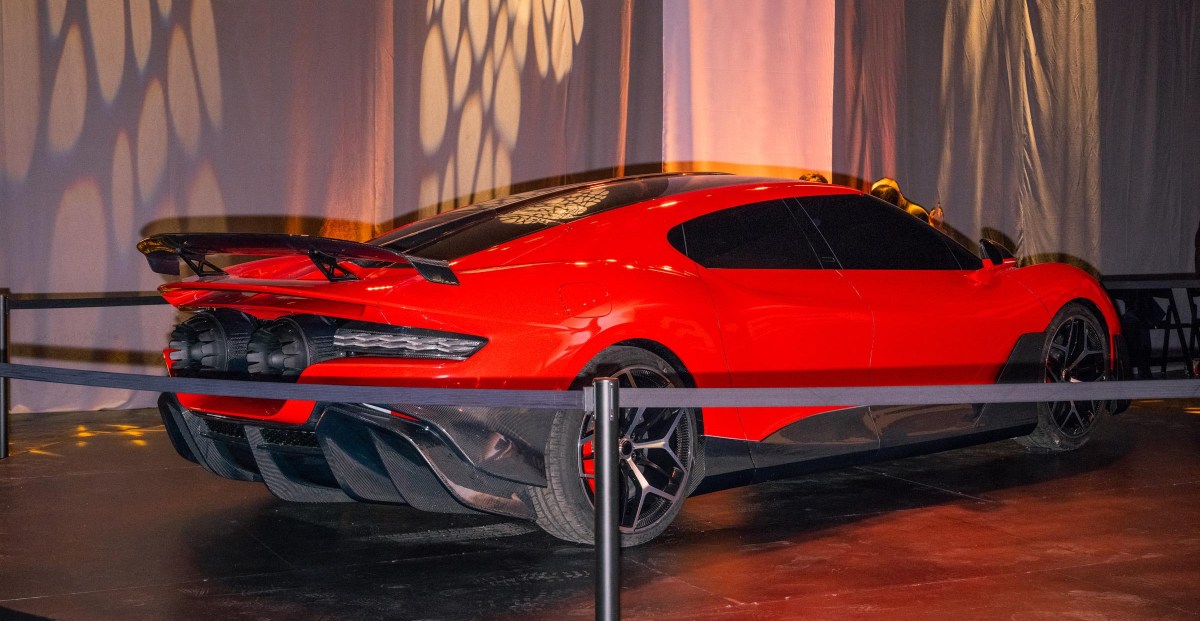
Not even five months later, Dreame is back with another car — and this time, they really outdid themselves. The company claims that its Nebula NEXT 01 Jet Edition, equipped with a pair of “rocket engines,” can accelerate from 0 to 60 mph in 0.9 seconds.
Not only is that quicker than anything ever made, it is most likely physically impossible. Modern tires simply do not have the grip to allow for that kind of acceleration. As long as traction remains a real concern, there’s not a car in existence that could achieve this.
Even in an all-wheel drive configuration, modern hypercars are “traction limited.” They may have the horsepower to spin their wheels indefinitely, but the limiting factor is how much force the tires can transfer to the ground before they break loose and starting smoking. To get to 60 mph in under a second, you’d need to exert immense force instantly. Your average tires certainly couldn’t handle this amount of torque without slipping. Drag racers can get close by using sticky rubber and prepping the track. But a normal street car driving on normal pavement would simply burn out.

Dreame’s solution to this is “custom-built dual solid rocket boosters” that go beyond mere horsepower. The company claims its boosters deliver 100 kilo-Newtons of force. Mathematically, that would probably be enough force to accelerate the car, but — again — we need to acknowledge the physical limitations of applying that force to the road. If it were operating in a vacuum or on a surface with infinite grip, then yes, enjoy your rocket-boosted acceleration. But here in the real world, the laws of physics still apply.
There has been some advancement in sub-1-second 0–60 acceleration. A few years ago, a team of students at the Academic Motorsports Club Zürich and the Swiss universities ETH Zürich and Lucerne University of Applied Sciences and Arts built an ultra-light racecar that did it in 0.956 seconds, but it weighed about 300lbs and doesn’t have a roof.

The Autopian sent an engineer to Dreame’s expo is San Francisco to check out the Nebula NEXT 01 in the flesh, and his assessment was “feels like horseshit.” He noted that the rocket boosters appeared to be fabricated to look like rocket boosters. And apparently there were no air inlets or outlets, which raises further questions about how this thing is supposed to function in the real world.
There’s nothing wrong with being ambitious, and Dreame certainly has communicated its clear desire to take over the world. But as its been stated before, 0–60 times are a silly metric by which to judge performance. I get that its a commonly accepted way of talking about acceleration that most people can grasp. But as automakers and upstarts like Dreame keep trying to one-up each other in the 0–60 leaderboard, things are quickly getting out of hand.
I wouldn’t worry to much about it, though. Dreame is facing an uphill battle if it wants to become an automaker, its spurious rocket-booster plans notwithstanding. The Chinese EV market is rapidly contracting, as a vicious price war is making it incredibly difficult for niche brands to break through.
Of course, Dreame’s not alone in trying to sell the world on a fabulous promise of rocket-boosted power. The next-generation Tesla Roadster is supposed to feature an optional “SpaceX package” with cold-gas rocket thrusters that are designed to enable sub-1-second 0–60 acceleration. Elon Musk promised the new Roadster would be revealed in April 2026, but shockingly that month came and went with no Roadster.
Can Dreame beat the world’s richest man to market with its fake rocket-booster technology? If a vaporware car accelerates 0–60 in under 1 second and no one is around to see it, does it exist?